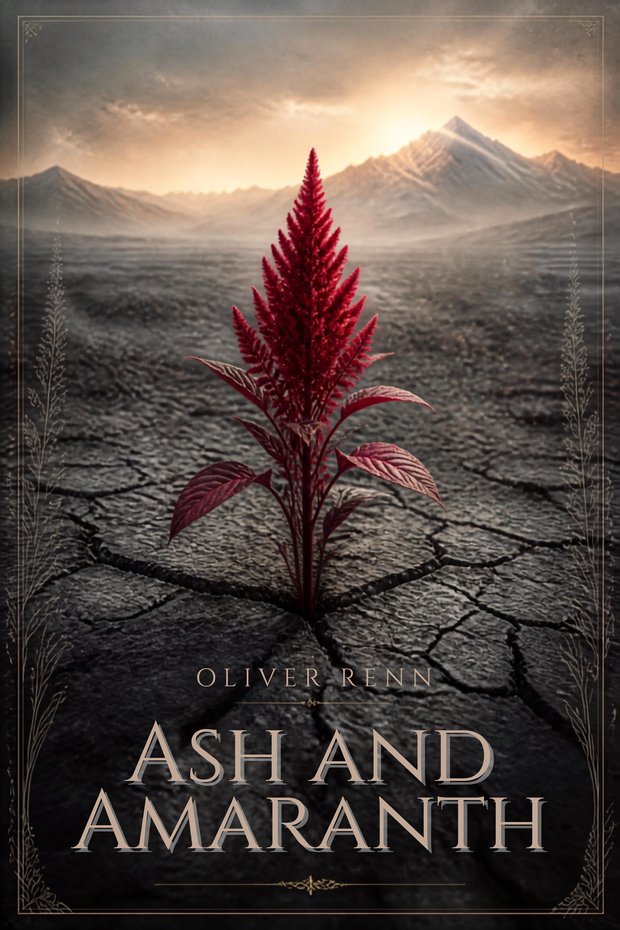
Chapter One: The Unfading Grove
The amaranth tree stood alone at the heart of the Sanctuary Garden, and Wren Calder had never once seen its blossoms brown. She was seventeen that spring, apprenticed four years into the Verdant Guild, and she had cut flowers from that tree a hundred times without the cuttings ever curling or fading in the vase, not after a week, not after a month. The guild called this the tree's first mercy. Old Master Perrin Sorrel called it something closer to a warning: that a thing which refuses to die quietly is a thing worth asking why.
The Guild had kept this single tree under royal charter for three hundred years, ever since the groves of Queen Maren's day had dwindled to this one matriarch, silver-barked and broad as a barn, her canopy hung with blossoms the color of a coal's last heat. There had been whole amaranth forests once, in the high valleys before the old wars thinned them, and smaller stands after that before blight and frost took the rest. This was the last. Wren had grown up knowing that word the way other children knew their own surname — last, last, the last amaranth in the kingdom of Aldermere, and hers to help tend.
Its bark flaked in thin coppery curls that the guild swept each morning and burned in censers for the sick, because amaranth ash drew infection from a wound the way a poultice drew a splinter. Its sap, when the trunk was nicked for harvest, sealed a cut almost before the blood could rise. It had not set seed in nineteen years. A tree that could not fade could apparently also, it seemed, forget how to begin again — self-barren, Master Perrin said, needing a second tree it did not have, waiting on a future nobody alive expected to see.
That morning Wren swept bark-curls into a copper pail and listened to the guildhall bell toll the hour, and three valleys to the east, though she did not yet know it, smoke was already rising over a town called Fenhollow, where soldiers of the Lord Protector's Cinderwatch had burned a chapel to the old Rite and called it good work finished before breakfast.
Chapter Two: Smoke on the Wind
They came up the river road on a grey morning eleven days later, forty men under a captain named Ossian Vey, with torches already lit against the damp and a writ from the Lord Protector's own seal ordering the destruction of any shrine, sigil, or gathering-place of the outlawed Amaranthine Rite. Nobody in that company had ever read the Guild's charter, nor cared to. They saw a walled garden with a great flowering tree at its center, its blossoms shaped like the rebel sigil stitched on the banners they had been burning for three months across two provinces, and to them that was evidence enough.
Master Perrin met them at the gate with the charter itself held open in his burned, ink-stained hands, reading the royal seal aloud as if volume could undo forty torches. Captain Vey read perhaps four lines of it before the wind took the rest. He was not, Wren understood later, an unkind man — only a tired one, under orders from officers who were under orders from a Lord Protector three years into a peace he did not trust, and he had buried men under banners bearing that same copper-red bloom.
Wren watched from the toolshed doorway as two soldiers put their shoulders to Master Perrin and moved him bodily from the gate, and when he would not stay moved, a third struck him across the jaw with the flat of a hand and left him in the mud with his charter trampled beside him. She did not remember deciding to run toward him rather than away. She remembered only his blood on the page, and the first torch going up into the lowest branches with a sound like a held breath finally let go.
The amaranth did not burn quickly — its sap resisted flame longer than any green wood should — and so the soldiers fed it through the whole grey length of that day, dragging brush and oil up from the road when the first fires guttered, until what had stood three hundred years became, by dusk, a column of black smoke visible from the capital road. Wren held Master Perrin's head out of the mud and watched the last amaranth tree in the kingdom of Aldermere go down into coals, and she did not cry, not then, because some part of her was already doing arithmetic with what little might be left to save.
When the soldiers finally marched on toward the next valley, satisfied, Captain Vey paused at the gate and looked back once at the smoking ruin, and Wren would remember that look for a long time afterward without being able to name what was in it — not triumph, not quite regret, but something closer to a man checking a box he had been told mattered more than it did.
Chapter Three: What the Ash Remembers
She went back at first light, when the coals had cooled enough to walk among, with her sleeves pulled over her hands and her eyes stinging from more than smoke. The garden she had known her whole apprenticeship was a black socket in the earth, the great canopy reduced to a lattice of grey char that crumbled at a touch, the air still ticking faintly with heat. She had come looking for nothing in particular — some instinct to bear witness, perhaps, or simply an unwillingness to let the first morning after belong entirely to the soldiers.
What she found, she found because Master Perrin had taught her, in her second year, about the failsafe the old guild masters had built into every mature amaranth: a single seed-pod each generation, sealed deep in a fissure of the root crown in a resin the tree wept only once a decade, proof against flood, frost, and — though nobody had truly believed they would need it — fire. She remembered his telling her this as a curiosity, a piece of guild trivia half-mythical even to him, and she knelt at the ruined root crown less in hope than in the stubborn need to have looked.
The resin had blackened and cracked but not burned through. Inside, no larger than a hazelnut, sat a seed-pod the deep glossy black of a crow's eye, cool to the touch even with ash still smoking an arm's length away. She worked it free with a garden knife and her own shaking fingers, and when it came loose into her palm it felt absurdly light for the weight it would come to carry — the last amaranth seed in the kingdom of Aldermere, and nobody living, not even Master Perrin, certain of exactly how to wake it.
She did not tell the soldiers camped a mile off, and she did not yet tell the guild council, gathering even then in emergency session to discuss charters and culpability and the shape of the trouble to come. She told no one but the seed itself, wrapping it in a scrap of undyed wool and tucking it against her sternum where she could feel it through her shirt, and she walked back to the guildhall already rehearsing, without knowing it, the first lie of a four-year campaign to keep one small black pod a secret worth keeping.
Chapter Four: The Guild in Mourning
The guildhall that week smelled of bandages and burnt wool and the particular silence of people afraid to say aloud what they were thinking. Master Perrin's jaw was wired and his right hand, badly burned reaching for a branch he could not save, would never again hold a grafting knife steady. The council met twice daily — nine senior journeymen and the two remaining masters, arguing in low voices about the charter, about whether the Lord Protector's writ had technically superseded three centuries of royal grant, about whether the guild itself might now be read as sympathetic to the outlawed Rite by association and dissolved for it.
It did not help that the Amaranthine Rite had, within living memory, claimed the tree as their own holy relic — a twisting of history the guild had watched happen and been powerless to stop, the old folk reverence for Queen Maren's unfading blossom curdling slowly into the banner of men who wanted a war. Half the kingdom now could not look at a copper-red flower without thinking of burned granaries and a failed uprising three years cold. The guild had tended the tree for the crown for ten generations before the Rite ever existed, and that distinction, Wren was beginning to understand, would matter to almost no one who had lost a brother to the Ember Uprising.
Journeyman Cob Ardry said as much at the second council meeting, not unkindly but without much patience either: that the tree was gone, that mourning it further served nothing, that the guild's real and pressing work was the orchard contracts and the root-cellar seed stores that would feed three villages through a hard winter, and that grief was a poor excuse to neglect living obligations for a dead one. Several of the older journeymen nodded. Wren, sitting at the back with the seed still hidden against her skin, said nothing at all, and hated herself a little for the silence even as she kept it.
That night she brought the seed to Master Perrin in his sickroom, setting it in his unburned palm with both her hands shaking more than his. He looked at it a long time without speaking, turning it once in the lamplight, and when he finally looked up at her his eyes were wet in a way she had never seen from him, not even at the grove. "Then we are not finished," he said, "only beginning something harder," and that was the moment Wren understood her apprenticeship had just become something else entirely.
Chapter Five: The Weight of a Single Seed
Master Perrin could not hold a knife, but he could still talk, and over the following weeks he gave Wren everything he had — not as lecture but as confession, the accumulated, half-superstitious, half-empirical lore of ten generations of guild masters who had never expected to need it in earnest. The amaranth's seed-coat, he explained, was sealed against rot and rodent alike by a resin so tough it would not crack on its own in a hundred years; it needed fire, a specific unhurried heat, to split it open, which was why the old masters had built a ritual around exactly that: the Ember Rite, a controlled burn performed once a generation at the grove's edge, never at its heart.
But fire alone would only crack the coat, not coax a seedling from it. The tree's roots, he told her, did not feed alone in soil; they depended on a fine silver-grey fungal thread the old texts called tindermoss, which sporulated only in ash and which lived, so far as anyone living knew, nowhere else in the kingdom but in that one garden's soil — soil now scorched to depths no one had measured. Without it, a cracked seed might swell and rot as easily as sprout. And even if it sprouted, grew, and in seven years or more finally bloomed, it would bloom alone, self-barren as its parent, waiting on a second tree that did not exist to make the waiting mean anything.
Wren asked him, on the worst of those nights, why any of it was worth attempting if the best outcome was one lonely tree that could never seed itself again. Master Perrin was quiet long enough that she thought he had fallen asleep before he answered. "You are not growing it back," he said. "That tree is ash, and ash does not unburn. You would be growing something new that happens to come from the same seed — and whether that is worth doing is not a question the old tree gets to answer for you. It never asked to be saved. It only asked, same as anything living, to be let finish becoming whatever it was going to become."
She did not fully understand him that night, not in the way she would come to later, but she carried the sentence with her the way she carried the seed itself: close, half-understood, and impossible to set down. The next morning she began, in secret and on her own time, to search the guild archive for every surviving record of the Ember Rite, while telling the council, when asked, only that Master Perrin's recovery was slow and that she was needed at his bedside more hours than not — which was true, and which was also the second lie in a campaign that would eventually require a great many more.
Chapter Six: Old Books, Older Rites
The guild archive occupied three low rooms beneath the hall, shelved floor to ceiling with seed-ledgers, grafting charts, and the spidery marginalia of gardeners three centuries dead, and Wren spent every stolen hour of that autumn among them with a shuttered lamp and a guilty conscience. She learned that Queen Maren herself, fleeing the clan wars that preceded Aldermere's founding, had carried a single amaranth cutting through two winters of exile, and that the first grove had been planted on the exact spot where she finally turned to fight rather than run — which was why, for three hundred years, the tree had stood for endurance bought by refusal rather than luck.
She learned, too, exactly how the Rite had gotten hold of it: a breakaway sect of guild lay-workers two generations back, devout and increasingly desperate as the grove's seed-set failed year after year, had begun to read the tree's barrenness as a divine rebuke and its unfading blossoms as a promise of resurrection still owed to the faithful. What began as reverence calcified, across one bad harvest and one bad regent after another, into the Ember Uprising — men marching under a copper-flower banner to burn granaries they believed the crown had starved on purpose, certain the old saint-queen's tree would bloom again only once the wrongs against her people were avenged.
The Ember Rite itself, the controlled burn, was recorded in only one surviving ledger, written by a guild master four generations back in a hand so cramped Wren had to copy each line onto slate before she could be certain she had read it right: a slow fire of dried grove-litter banked at the garden's edge, burned only on a still, damp morning, kept low enough that a hand could pass through the smoke without blistering — heat enough to crack a seed-coat, nowhere near enough to kill the green wood around it. It was nothing at all like what Captain Vey's men had done, and reading that distinction in black ink made something in Wren's chest go very cold and very clear at once.
She copied the whole procedure twice, once for the archive's sake and once folded small into her boot, and she understood, closing the ledger that night, that what she intended to attempt was in every practical sense the same act the Rite itself had once performed in the grove's honor — a fire lit deliberately around a sacred tree — and that if anyone in the Lord Protector's service ever learned of it, the distinction between devotion and sedition would not save her any more than the charter had saved the grove.
Chapter Seven: The First Fire
She chose a hollow a half-day's walk from the guildhall, on land nobody farmed and nobody watched, and she built the fire exactly as the old ledger instructed: a shallow pit, dried amaranth litter she had salvaged and dried from the ruin itself, banked low and smoking rather than flaming, on a grey damp morning when the smoke would sit close to the ground rather than signal itself for a mile. She held the seed in a pair of iron tongs an inch above the coals for the span of time the ledger called the length of a slow hymn, turning it twice, and when she finally drew it back its black coat had split clean along one seam, pale green showing through like a closed eye about to open.
She planted it that same afternoon in a clay pot of soil she had carried, basin by basin, from the ruined grove itself — the only soil in the kingdom, she reasoned, that had ever known an amaranth's roots. She watered it with river water boiled and cooled, kept it in the warmest corner of the potting shed, and checked it twice a day for three weeks with a hope so carefully rationed she was almost proud of how little she let herself feel it.
Nothing came. By the fourth week the seed, dug up gently to check, had gone soft and dark at one end, rot creeping in along the crack she herself had opened, and no amount of staring at it changed what was plainly, undeniably happening. She brought it to Master Perrin white-faced and apologizing before she had even set it down, certain she had killed the last hope the kingdom had in one careless afternoon.
He turned the ruined seed over in his good hand for a long moment, and then he asked her a question that had not occurred to her at all: whether the soil she'd carried from the grove had still smelled of anything green, or only of char. She realized, with a sick drop in her stomach, that it had smelled of nothing but ash — because whatever lived in that soil before the fire, whatever fine silver thread the old texts called tindermoss, had very likely burned to nothing along with everything else. The fire had cracked the seed correctly. It was the ground itself that could no longer hold it, and that, Master Perrin said gently, was a different and perhaps harder problem to solve.
Chapter Eight: Journeyman Cob's Doubt
Word got around the guildhall the way word always does, not through confession but through absence — Wren missing mealtimes, borrowing tools nobody else needed, smelling faintly of woodsmoke on mornings she claimed to have been at market. Journeyman Cob confronted her in the tool-room rather than the council chamber, which she later decided was almost a kindness, though it did not feel like one at the time. He did not raise his voice. He simply asked her, plainly, how many hours of guild time — his time, the guild's collective time, time owed to three villages who would eat thinner this winter for every hour not spent in the working orchard — she had spent chasing a tree that by every practical measure was already gone.
She did not have a good answer, because the honest one — that she could not explain why it mattered so much except that Master Perrin had asked her not to let it finish dying alone — sounded, said aloud, exactly as foolish as Cob plainly believed it was. He was not cruel about it. He told her he had lost an uncle to the Ember Uprising, a good man talked slowly mad by a banner and a promise of blooming, and that he had no patience left for anything with that flower's shape, living or dead, whatever the Guild's old charter said about duty.
The council, when it finally took the matter up formally, split along a line Wren had not expected: not masters against apprentices but the war-weary against the stubborn, with Master Perrin — still wired-jawed, still speaking slowly — arguing with more force than his injuries should have allowed that a guild which abandoned its charter the moment it became costly was not a guild worth the name it had carried for three centuries. They did not forbid her the work. They also did not fund it, assign her fewer hours elsewhere, or spare her a single apprentice's share of the orchard labor, which amounted to the same restriction dressed in gentler language.
So she worked the seed-problem in the hours properly belonging to sleep, and she told herself, lying awake with dirt still under her nails, that Cob was not wrong to doubt her, only wrong about what the doubt should cost her — because a thing could be both a foolish use of scarce hours and the only use of them she could not make herself set down.
Chapter Nine: Aunt Esme of the Hedges
It was Master Perrin who finally remembered the old woman — Esme Loel, who had tended the grove's outer hedge as a hired laywoman for nearly forty years before the guild tightened its charter and let her contract lapse, and who had lived alone at the garden's edge long enough to know its soil the way a mother knows a child's fevers. Wren found her cottage a mile past the ruin, shutters closed against a view she evidently could no longer bear, and when Wren explained, haltingly, what she had come for, Esme did not answer for so long that Wren nearly left.
"I buried my son under that hedge's shade the year the Uprising took him," Esme said finally, not looking up from her mending. "He went off to fight for a flower he'd never once helped me prune. You'll forgive me if I'm not overjoyed to hear it might grow back." Wren had no answer for that either, and offered none, and it was the silence she kept rather than any argument she made that seemed, eventually, to move the old woman — as though what Esme needed was not to be persuaded but simply to be allowed her grief without an apprentice rushing to paper over it with purpose.
In the end Esme rose without further explanation and came back from a root cellar with a sealed clay jar, decades old by its dust, packed with soil she'd taken from beneath the hedge the week before the guild let her go, kept all this time for no reason she could fully name except that throwing away the last of a thing she'd loved had never once felt like the right use of her hands. When Wren held it to the light she could see, faint as frost on a window, threads of silvery fungus laced through the dark soil — tindermoss, alive, dormant, decades patient.
Esme made her promise one thing before she'd part with it: that whatever grew from it would belong to no banner, no Rite, no uprising, living or dead — that it would be allowed, if it grew at all, to be only itself and not anyone's cause. Wren promised it easily, not yet understanding how hard a promise that would turn out to be to keep, and walked the mile back to the guildhall cradling the jar against her chest the way she had once cradled the seed, already half in love with the small grey threads of a fungus she could not yet be sure would save anything at all.
Chapter Ten: What Grows in Ash
There was no second seed. There was only the one, rotted now past any hope of germinating, and so the real work of that winter was not planting but preserving — keeping Esme's jar of living tindermoss alive in guild soil, feeding it diluted ash-water by the week, waiting for it to spread through a fresh pot the way the old ledgers described, while Master Perrin's recovery stalled and Wren's private hours grew thinner and more exhausted by the month. It was not until early spring, nearly a full year after the burning, that the guild's own last hope arrived from an unlikely direction: the ancient amaranth itself, it turned out, had set a second failsafe pod the same generation as the first, not in the root crown but high in a fork of branch long since fallen and half-buried in the ruin's own ash, overlooked because no one had thought to look up as well as down.
Wren found it while sifting char for a wholly unrelated reason — salvaging bark-curl ash for the guild's infirmary censers — and recognized the glossy black shape before she had fully registered what her hands were holding. This time she did everything differently. She cracked it with the same careful fire, in the same damp hollow, but she planted it directly into a bed of Esme's tindermoss-laced soil rather than the lifeless grove earth she'd used before, and she did not check it twice a day. She checked it once a week, forcing herself, because Master Perrin had told her that hope handled too often wears thin as old cloth.
Five weeks passed with nothing visible at all, and Wren spent most of them convinced she was simply failing more slowly this time rather than differently. Then, on a grey morning not unlike the one the soldiers had come on, she lifted the pot's soil an inch at the rim, as she had promised herself she would allow just once, and found a single pale root, no thicker than a thread, curled white against the dark earth and unmistakably, stubbornly alive.
She did not call for Master Perrin. She carried the whole pot to his sickroom herself, setting it on the blanket across his knees with hands that would not quite stop shaking, and watched his face while he turned the pot slowly in the window light to find the thread of root against the soil. He did not speak for a long while. When he did, his voice was thick in a way that had nothing to do with his wired jaw. "Well," he said. "Now the hard part starts."
Chapter Eleven: Roots Taking Hold
The seedling, when it finally broke soil three weeks later, was an unremarkable thing to look at — two pale leaves no larger than a thumbnail, stem thin as a grass blade, nothing in its appearance to suggest it was the last living descendant of a three-hundred-year-old tree that had once stood taller than the guildhall roof. Wren moved it to a deeper pot, then a larger one again by midsummer, and built around its care the kind of obsessive, humbling routine that farming had always demanded of anyone honest about it: watering calibrated to the week's rain, a cloth shade rigged against noon sun too fierce for new growth, a nightly watch for the slugs that seemed to find one precious seedling faster than they ever found a whole bed of cabbages.
She lost it once, almost, to an early frost in its first autumn — a cold snap two weeks ahead of any almanac's prediction, and only Master Perrin's insistence, shouted from his sickbed when she told him the forecast, that she move the pot indoors that very hour rather than wait till morning, saved it from a night that killed half the guild's unprotected seed stock outright. She slept beside the pot for three nights after that, on the potting-shed floor, not trusting herself to trust the weather again.
Master Perrin's own health did not follow so forgiving a curve. The burn across his hand had healed crooked and would not fully close, prone to fevers that came and went through that whole first year, and though he never said so outright, Wren began to understand, watching him tire earlier each week, that some cost of the burning had simply never finished being paid by anyone who'd stood close enough to the fire. He taught her anyway, from his bed more often than not by the second winter — grafting theory, soil chemistry, the slow guild math of what a tree needed across a decade rather than a season — as if he had decided, without saying so, that the teaching itself was now a kind of race.
By the second spring the seedling stood knee-high, its first true leaves broader and a deeper, more certain green than the delicate pair it had started with, and Wren had stopped, almost without noticing, being only an apprentice stealing hours for a private project and become, in practice if not yet in title, the guild's sole working expert on a species nobody else alive had ever successfully raised from seed. It was, she would think later, the quietest kind of growing up there was — not a single dramatic turn but a hundred small mornings of watering, watching, and worrying, until one day the worrying had simply become who she was.
Chapter Twelve: The Captain's Visit
Captain Ossian Vey returned to the guildhall in the sapling's second autumn, not with forty men and torches this time but with four, and a face that suggested he found the errand at least as unwelcome as his hosts did. Word had reached the garrison, he said, standing stiffly in the guild's receiving room with his helm under his arm like a man at a funeral, of smoke and ash-burning on guild land at unusual hours, and of something green growing where the old shrine had stood — and the Lord Protector's standing edict on any regrowth of Rite symbolism left him, he said, very little room to simply look away a second time.
Wren stood beside Master Perrin's chair with her heart going hard enough that she was certain the captain could hear it, and it was Master Perrin, voice thin but level, who answered him — not with the charter this time, which had done them no good before, but with plain fact, offered without apology: that the guild had cultivated amaranth under royal grant a thousand years before any Rite existed to misuse it, that a seedling seven years from its first bloom posed no conceivable rallying power to anyone, and that the captain was welcome to inspect a two-foot sapling himself and judge whether it looked, to his own eyes, like a weapon worth marching on.
Vey walked the short distance to the potting shed himself, alone, while his men waited at the gate, and stood looking at the sapling for longer than Wren found comfortable, long enough that she began composing, in her head, what she would say if he ordered it burned where it stood. He did not. He asked her, instead, without looking away from the small green thing, whether she had been the one kneeling in the mud the day his men put Master Perrin on the ground — and when she said yes, he was quiet a moment longer before saying that he had thought of that morning more often than he'd expected to, in the years since.
He left without the sapling and without, he made plain, any promise that the next inspector sent would be so inclined to leave empty-handed. "I can slow this down once," he told Master Perrin at the gate, not unkindly. "I cannot promise to be the last man the Lord Protector sends." It was not protection. It was, at best, a postponement bought on the strength of one soldier's private unease, and Wren understood, watching him ride off, that whatever time that bought her was time she could not afford to waste.
Chapter Thirteen: Master Perrin's Leaving
He went through that whole third winter more slowly than the one before, and by early spring the fevers that had always passed stopped passing, settling instead into something the guild's own healers spoke about in the careful, rehearsed tones Wren had learned to dread. She moved her cot into the room beside his, and split her days between his bedside and the sapling's, as though tending both at once might somehow keep either from slipping. Master Perrin himself seemed, if anything, less afraid of what was happening to him than she was, and more interested, in those last weeks, in making certain she had everything of his that mattered before there was no longer time to give it.
He formally named her journeyman before the full guild council on a morning he insisted on sitting up for, his wired jaw healed crooked, his burned hand resting useless in his lap, and told the assembled masters in a voice that carried further than anyone expected from so frail a man that the guild's charter over the last amaranth in the kingdom passed, from that day, to Wren Calder, and that any council member who thought a two-foot sapling unworthy of a full journeyman's attention was welcome to say so to his face while he still had one to hear it with. Nobody did.
In private, in the days after, he told her the things he had apparently been saving — not instructions, she realized, since he had already given her all the instructions he had, but something closer to release. He told her that he had spent forty years believing his life's great work was keeping one ancient tree alive exactly as it had always been, and that the fire had taught him, cruelly and too late for his own sake, that the keeping had never really been the point. "You are not raising Queen Maren's tree again," he said, the same thing he had told her once before, except that this time she finally understood it. "You are raising whatever that seed decides to become, which was never obligated to be the same thing. Don't you dare spend your whole life mourning that it isn't."
He died eleven days later, quietly, in the early hours of a morning Wren had not known would be his last until it already was, and the guild buried him not in the Sanctuary Garden's ruin, which still held too much smoke in its soil for any respectful grave, but beneath an old apple tree in the guild's working orchard that he had grafted himself as a young man. Wren planted a single amaranth leaf-cutting at the headstone's foot out of habit more than ritual, not expecting it to take root, and did not visit it again for a long while afterward, because some griefs, she found, needed tending less than others and more simply needed to be let alone.
Chapter Fourteen: A Season of Waiting
The guild did not fall apart without him, which surprised Wren more than it perhaps should have — the council elected a new senior master from among the remaining journeymen, Cob among them grudgingly, and the working orchards and seed stores carried on feeding three villages exactly as they had before, because guilds, like gardens, are built to outlast any single gardener. What changed was smaller and more personal: Wren found herself, for the first time, the person others came to with questions about the sapling rather than the person sneaking hours to tend it unseen, and she discovered that the secrecy she had maintained so carefully for two years had cost her something she hadn't noticed losing — the simple, ordinary pleasure of being proud of the work in front of people.
Cob, of all people, became something like an ally in that second year after Perrin's death, not through any sudden conversion but through the plain accumulation of evidence: he watched her work through two winters, watched the sapling survive a frost that had nearly taken it once already, watched her turn away offers of easier apprenticeships elsewhere to keep tending a tree that cost the guild nothing now but her own labor, and he told her once, gruffly, over a shared meal in the tool-room, that he still thought the old tree's history was a poor thing to have died for, but that he no longer thought she was a fool for trying to give it a better one.
The sapling itself, by the close of its third full year, had grown taller than Wren's shoulder, its bark beginning to show the first pale flaking that would one day, decades off, become the silver curls she remembered from the old matriarch tree, and its canopy had filled out enough that she began, cautiously, to imagine the shape it might eventually take — not the grove's old shape, she reminded herself deliberately whenever the thought arose, but its own, whatever that turned out to be. She kept Esme's promise scrupulously, telling no pilgrim, no passing traveler, no curious villager what exactly grew behind the guild's high wall, letting it be, for those years, only a tree and nothing more.
It could not last, of course, and some distant, watchful part of her had known that from the first morning she'd knelt in the ashes with a seed in her palm. Word of a thing that refuses to stay hidden eventually refuses it regardless of how carefully it is kept, and in the spring of the sapling's fourth year, word of the Verdant Guild's amaranth finally reached further than the guild wall, further than Captain Vey's garrison, all the way to the regent's own court at Averlyn, carried, as it turned out, not by malice but by something almost worse: an innocent letter from a traveling botanist who had glimpsed the tree over the wall and written of it, with scholarly delight and no political sense whatsoever, to a colleague at court.
Chapter Fifteen: The Edict
The Lord Protector's inspectors arrived on a morning bright enough that the irony of it stung — no torches, no soldiers, only two clerks and a magistrate's writ renewing, in sterner language than before, the standing ban on any cultivation, display, or propagation of amaranth blossoms anywhere in the kingdom, the decree freshly sharpened by an unrelated flare of unrest in the eastern provinces where a handful of old Rite sympathizers had, that same spring, tried and failed to rally a second, smaller uprising under a stitched copper-flower banner of their own devising. The timing could not have been worse, and Wren understood, reading the writ over the magistrate's shoulder, that the sapling had just become collateral in a fight it had never asked to join, fought by people who had never once seen it.
She did the only thing she could think to do, which was refuse to let the sapling be judged in absence: she requested, formally, through the new guild master and with Captain Vey's own reluctant backing, a hearing at Averlyn itself before any order to destroy it was carried out — an audience, if one could be granted, with whoever in the regency actually held the authority to decide such a thing. It took six weeks of petitions and Vey's own testimony, offered at some professional risk to himself, that the tree in question was a two-foot sapling with no bloom and no following, before that audience was finally granted, and granted, strangely, not with the Lord Protector himself but with the young Queen Isolde, fourteen now and beginning, by custom, to sit in on matters that would one day be entirely hers.
Wren traveled to Averlyn with a single potted cutting taken carefully from the sapling's own lower branch, a slip no longer than her forearm, because she judged, rightly as it turned out, that no argument she could make in words would carry half the weight of the plant itself standing green and ordinary and unthreatening in a clay pot before a throne. The court chamber was colder and grander than anything she had stood in before, full of advisors whose faces she could not read, and the Lord Protector himself sat beside the young queen's chair with an expression that told her plainly he considered the whole audience a formality he intended to end quickly and in his own favor.
It was the queen, not the regent, who finally spoke first, leaning forward to look at the small cutting rather than at Wren, and asking — with a bluntness that startled the whole chamber into silence — whether it was true that the flowers never faded even after they were cut. Wren said that it was true. The queen asked why that should frighten anyone enough to want it burned twice. Nobody in the chamber had an answer ready for that, least of all the Lord Protector, and Wren understood, watching the girl's face, that she had just been handed, entirely by accident, the only opening she was likely to get.
Chapter Sixteen: What It Can Become
Wren had rehearsed a dozen arguments on the road to Averlyn, about charters and precedent and the distinction between a relic and a rebellion, and she abandoned every one of them the moment the young queen asked her question, because she understood, finally, that the court did not need a better legal case. It needed to be shown, plainly, what the thing actually was rather than what it had been made to stand for. So she told them instead about the sap that sealed a soldier's wound faster than any bandage, Cinderwatch or guild or villager alike, because the tree had never once in three hundred years asked whose side a wounded hand belonged to. She told them about the ash that drew infection from a cut, used in guild censers to treat the sick regardless of banner. She told them, last, about Esme Loel, who had buried a son under the old hedge for a cause the tree itself had never once asked him to die for, and who had kept its soil alive anyway, not for the Rite's sake but in spite of it.
"It does not hold a grudge the way we do," Wren said, and heard her own voice shake and did not try to steady it. "It does not remember being a sigil any more than it remembers being Queen Maren's cutting. It only remembers how to grow. The Rite took its flower because the flower was beautiful and stubborn, and then the Rite died of its own failure, and the flower is still here, not because anyone let it keep being what it was, but because it was never actually that in the first place — it was only ever a tree that people kept deciding, generation after generation, what it should mean. I am asking you to let it mean something new."
The Lord Protector argued, as she had expected, that symbols outlive the arguments that killed them and that leniency here would read, to a kingdom barely three years past an uprising, as the crown quietly forgiving what it could not afford to forgive. He was not entirely wrong, and Wren did not pretend otherwise when her turn came again, only offered, in place of denial, a compromise she had not planned to propose until the words were already leaving her: that the guild would plant no grove, raise no second tree in secret, make no shrine of it at all — that it would stand, singly, behind the guild's own wall, tended as a horticultural specimen and nothing more, its sap and ash used openly for the sick of any province, any allegiance, with the guild itself answerable for any sign it was being read as anything other than that.
It was Queen Isolde who decided it, in the end, overruling her regent's recommendation with a plainness that made several advisors visibly flinch — not because she had been moved by mercy alone, Wren suspected, but because some part of a fourteen-year-old queen recognized something of her own situation in a sapling being told it had to finish growing into whatever it was going to be while the whole kingdom stood around arguing about what it used to mean. The order that left Averlyn that week protected the tree under the guild's existing charter, named it formally a medicinal specimen rather than a relic, and forbade — on pain of treason, which made Wren laugh once, disbelieving, when she finally read the phrase alone — anyone from using its image as a banner for any cause whatsoever, ever again.
Chapter Seventeen: Ash and Amaranth
Five years after the burning, the sapling that had once fit inside a clay pot small enough to carry in both hands stood taller than the guildhall's lower roof, its bark just beginning to show the first silver flaking Wren remembered from the tree that made it, its canopy, that spring, heavy for the first time with buds the deep coppery red of a coal's last heat. It would be two more years at least before those buds opened into true bloom, and longer still before anyone knew whether a tree raised so far from its own kind would prove as unfading as its parent, or different in ways no ledger could have predicted — and Wren had stopped, by then, needing to know the answer before she could love the question.
She wore, that spring, the field-name the guild had finally given her at her full raising to master the previous autumn — not Calder any longer in guild record, but Wren Amaranth, a name no apprentice had earned outright in three generations, given not for saving the old tree, which no one could have done, but for the years of unglamorous, undramatic work of growing something new in its place. Cob had proposed the name himself at council, gruffly, as if embarrassed to be caught admiring anything, and Wren had cried at that more than she had at almost anything else in five hard years, which told her something true about which griefs had finally finished healing.
She still kept Esme's jar, emptied now, on the shelf above her own workbench, a reminder of a promise she had kept and a grief she had not talked anyone out of, and she visited the old woman twice a year still, bringing cuttings that would not root and news that Esme received with the same guarded quiet she always had — not joy exactly, but something Wren had come to recognize as its own kind of peace, the peace of a thing finally being allowed to be only itself.
The self-barren problem remained unsolved, and would for years yet: one tree could not seed a future any more than one seed pod hidden in a root crown could have been called a plan rather than a hope, and Wren had already begun, that spring, corresponding with a sister guild three provinces west rumored to hold, in some dusty unchecked archive, a single pressed specimen of amaranth pollen collected before the old wars thinned the forests — a longer, stranger, less certain search than the one that had brought her this far, and one she intended to begin in earnest the following summer. She did not know yet whether it would succeed. She had learned, these five years, not to need to know before beginning. What she knew instead, standing beneath a tree that was not the tree she had lost and had never been meant to be, was that some things are not saved for what they were, and that the saving, done right, was never really the end of the story at all — only the long, unglamorous, necessary beginning of whatever the thing still had left to become.